
The Problem With AI Website Builders
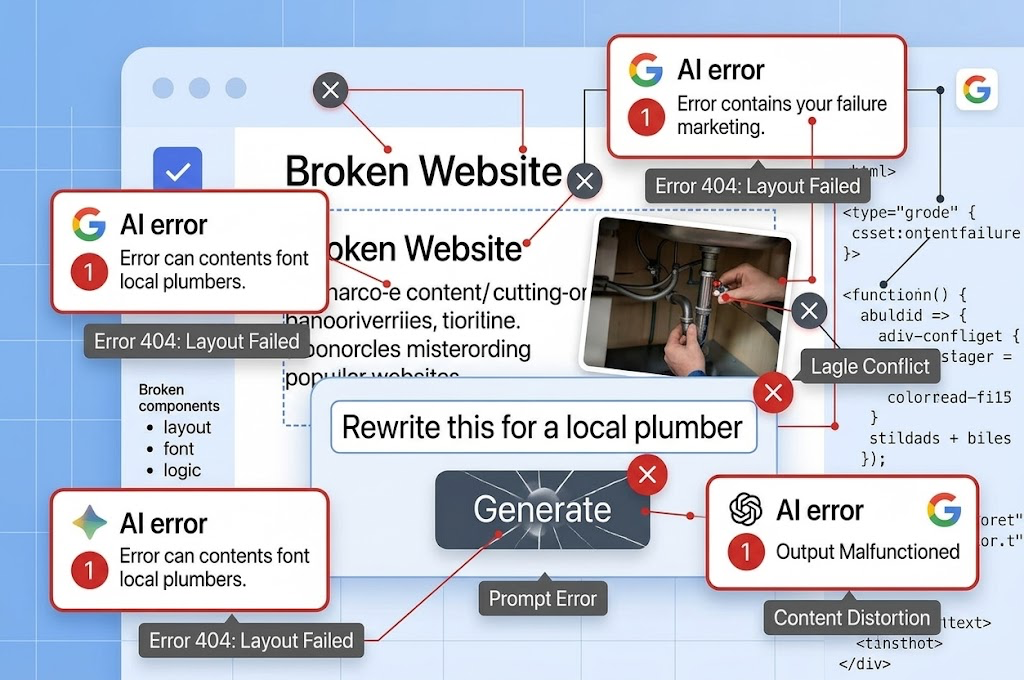
AI website builders have made it easier than ever to launch a professional-looking website. Tools such as Base44, Bolt, Replit, and others can generate layouts, pages, and website functionality in a fraction of the time required for traditional development.
However, a polished design does not automatically translate into search visibility. AI-built websites are automatically at a disadvantage when it comes to SEO because the generated site is created to match a prompt—not to meet every technical and content requirement needed to compete in search results. Even when a website looks impressive, important SEO elements can be missing or implemented incorrectly from the start.
In other words, an AI-built website should not be assumed to be SEO-ready just because it is live and looks professional. Without additional technical work and a deliberate content strategy, it starts with poor SEO foundations that can make it harder to get indexed, rank in Google, and generate organic leads.
Why AI-Built Websites Struggle to Rank on Google
One important consideration is how a website delivers its content to browsers and search engines.
Many AI website builders generate React-based single-page applications (SPAs) that rely on client-side rendering. In this setup, the browser receives an initial HTML document and JavaScript is then used to render much of the page content.
This process can work well for visitors. Search engines, however, need to crawl and render the page to understand its content. Google can process JavaScript, but rendering may take additional time and can introduce complications compared with serving content directly in the HTML.
If important text, links, metadata, or other page elements are not available or rendered correctly, search engines may have difficulty understanding the page. In some cases, this can delay indexing or affect how the page is interpreted.
This is one reason AI-built websites have poor SEO by default: the generated implementation does not automatically ensure that search engines can access every important page element correctly. Unless these details are checked and fixed, the website can launch with technical SEO problems already in place.
The SEO Limitations of Vibe-Coded Websites
Vibe coding allows people to create websites and applications by describing what they want in natural language and using AI tools to generate the implementation. This can speed up development, but search engine optimization still requires deliberate planning.
Several common SEO elements may be missing or incorrectly implemented on AI-generated websites.
Missing or duplicated meta tags. Each important page should have an appropriate title tag and meta description. Generic, missing, or duplicated metadata can make it harder for search engines and users to distinguish pages.
Unclear heading structure. Headings help organize a page and communicate its subject. A logical hierarchy of H1, H2, and H3 headings makes content easier to navigate. Duplicate or poorly structured headings can reduce clarity for both visitors and search engines.
Weak internal linking. Pages should connect to other relevant pages across the website. Internal links help visitors discover related information and help search engines understand the relationship between pages. A service page, for example, may link to related services, useful articles, or a contact page.
Rendering problems. When important content depends entirely on JavaScript, it is important to verify that search engines can render and access it. Client-side rendering is not automatically a ranking problem, but an implementation that prevents content or links from being discovered can create SEO issues.
Missing structured data. Structured data, often implemented using schema markup, provides additional context about the content of a page. Depending on the business and page type, it may help search engines interpret details about an organization, a service, or other relevant information.
These issues can occur on any website, but AI-generated websites are especially likely to launch with them because the builder prioritizes generating a working design over completing a full SEO implementation. That means an AI-built website should be treated as having poor SEO until its technical setup and page-level SEO have been reviewed.
Why AI-Built Websites Often Struggle With SEO
AI-built websites do not automatically arrive with the technical foundation needed to perform well in search. By default, they should be considered poorly optimized for SEO until someone reviews and corrects the setup. The technology used to create the website is only one part of the overall picture, but the initial AI-generated version is not a substitute for a proper SEO implementation.
A search-friendly website generally needs accessible content, unique and relevant page titles, a clear heading structure, fast and reliable performance, mobile usability, descriptive links, and appropriate image optimization. It also needs content that is genuinely useful to its intended audience.
For local service-based businesses, this includes clearly explaining the services offered, the locations served, and how potential customers can get in touch. Each important service page should provide meaningful information rather than repeating generic text with a different city name.
AI tools can help create the initial structure and content, but the finished website still needs review and optimization. Technical implementation, content quality, internal links, and ongoing maintenance all contribute to search performance.
AI search tools are another reason to keep website information clear and accessible. There is no guaranteed way to make a business appear in every AI-generated answer, but accurate business information and useful content can help establish a stronger overall online presence.
How Google Evaluates AI-Built Websites
Google does not automatically penalize a website simply because AI was used to build it or help produce its content. Search performance depends on many factors, including technical accessibility, content usefulness, relevance, and the overall page experience.
The risk arises when a website publishes large amounts of generic, repetitive, or unhelpful content without providing meaningful value. Content that could apply to almost any business in an industry may do little to answer a searcher's specific questions or distinguish one company from another.
For local service-based businesses, useful content should accurately reflect the company's actual services, experience, service areas, and customer needs. Original project examples, clear service descriptions, genuine customer feedback, and answers to common questions can make a website more informative and credible.
Technical accessibility and content quality should be treated as separate but complementary parts of SEO. A technically sound website can still struggle if its content is weak, while strong content may not reach its audience if important pages cannot be crawled or indexed properly.
How to Make an AI-Built Website More SEO-Friendly
An AI-built website can be improved through a combination of technical checks, content optimization, and ongoing monitoring.
- Check how search engines access the site. Review important pages to confirm that their main text, links, and metadata are accessible. Google Search Console's URL Inspection tool can help show how Google sees a URL and identify indexing or crawling issues. If a site relies on JavaScript rendering, investigate whether key content is rendered and discoverable.
- Set up Google Search Console. Search Console provides information about indexing, search queries, page performance, and technical issues detected by Google. Submit a sitemap when appropriate and review indexing reports regularly. Not every page needs to be indexed, but important pages should be accessible and eligible for indexing.
- Write unique titles and meta descriptions. Give each important page a descriptive title that reflects its topic and intended audience. Meta descriptions should accurately summarize the page and give searchers a reason to visit. Avoid duplicating the same metadata across unrelated pages.
- Build useful, specific content. Website copy should explain what the business does, who it serves, and what makes its services relevant. For a local service-based business, this may include detailed service pages, genuine examples of completed work, service-area information, and answers to frequently asked questions. Content should be written for people first, not just to repeat keywords.
- Use structured data where relevant. Structured data can help search engines interpret information about a business or page. Choose schema types that accurately describe the content, implement them correctly, and validate the markup. Structured data does not guarantee higher rankings or enhanced search results.
- Improve internal linking. Connect related pages with descriptive links. Blog articles can link to relevant service pages, and service pages can direct visitors to useful resources or contact options. Important pages should be easy to reach through the site's navigation and internal links.
- Review page speed and mobile usability. Test important pages on mobile devices and look for oversized images, unnecessary scripts, layout shifts, and slow-loading elements. A site should be usable and easy to navigate across screen sizes.
- Monitor performance and keep improving. SEO is an ongoing process. Review Search Console data, check for broken links and indexing problems, update outdated information, and improve pages based on what customers search for and the questions they ask.
Why a WordPress Website Can Be a Better Choice for SEO and Conversions
For many local service-based businesses, WordPress can be a stronger long-term choice than relying on a quickly generated AI website. WordPress gives businesses and their SEO providers more flexibility to build out service pages, publish helpful content, improve page titles and metadata, add relevant structured data, strengthen internal links, and connect the site with the tools needed to measure performance and generate leads.
That flexibility matters because SEO is not a single setting that can be switched on after a website is published. It involves building a clear site structure, creating pages around the services customers are searching for, making the content accessible to search engines, and improving the site as search data reveals what is working. WordPress can make that ongoing work easier to manage and expand as a business grows.
A website should not be treated as a digital brochure that simply looks attractive and sits online. Its job is to help the right people find the business, understand its services, trust the company, and take the next step. For a service business, that might mean calling, requesting an estimate, or submitting an inquiry. The real goal is to turn relevant organic traffic into qualified leads and, ultimately, paying customers.
This is where many AI-built websites fall short. They can be launched quickly and look polished, but a good-looking design does not automatically bring visitors to the site or convert those visitors into customers. Without a proper SEO foundation, useful service content, clear calls to action, and a conversion-focused structure, a website may attract little organic traffic and produce few meaningful inquiries. A site that is not built around being found and converting visitors can end up delivering very little business value.
WordPress is not automatically SEO-friendly just because it is WordPress, and it still needs thoughtful design, technical setup, quality content, and ongoing optimization. The advantage is flexibility: the site can be structured and improved around the actual goal of generating leads, rather than stopping at a finished-looking design. Choosing a platform is only one decision, but choosing one that supports long-term SEO and conversion improvements can make the work easier.
Shortcuts are not a substitute for a strategy. The goal is not simply to get a website online as fast as possible; it is to build a website that can earn visibility in search, give potential customers a reason to trust the business, and help turn that attention into real opportunities.
Why AI Website Builders Cannot Replace an SEO Strategy
An AI website builder can help create a website, but it does not replace an SEO strategy.
Website development and search optimization solve different problems. Development creates the pages and functionality. SEO helps search engines discover, interpret, and evaluate those pages while making the content useful to the people searching for it.
A website can be published in a short time, but building organic visibility often requires sustained work. Keyword research, useful content, technical optimization, internal linking, local business information, and performance monitoring all contribute to that process.
For local service-based businesses, the website should also make it easy for visitors to understand the services offered and take the next step. Clear calls to action, accessible contact information, and straightforward estimate or inquiry forms can help turn relevant website traffic into potential leads.
How to Improve Rankings for an AI-Built Website
When an AI-built website is not appearing in search results, begin by identifying the cause rather than assuming the platform itself is responsible.
Review the website in Google Search Console to see whether important pages are indexed and whether any crawling issues have been reported. Inspect key URLs, review their page titles and headings, check internal links, and test mobile usability and page performance.
Once technical issues have been addressed, evaluate the content. Does each page serve a clear purpose? Does it provide specific and useful information? Are the services and service areas described accurately? Is there a clear path for visitors to contact the business?
If these areas are in good shape, ongoing SEO work can focus on understanding relevant search terms, improving existing pages, publishing useful content, and tracking performance over time.
Some technical issues may require help from a developer or SEO professional, particularly when a site architecture needs changes to rendering, routing, metadata, or structured data.
The Bottom Line on AI Website Builders and SEO
AI website builders offer a fast way to create a website, but speed and appearance alone do not guarantee search visibility, organic visitors, or paying customers. AI-built websites automatically start with poor SEO because the initial generated site does not ensure that every technical SEO requirement has been properly implemented.
That does not mean an AI-built website can never rank. It means the site needs additional technical review, SEO configuration, and content optimization before it should be considered ready to compete in search results. Problems can include rendering, metadata, internal links, structured data, and weak or generic page content.
For local service-based businesses, a website should do more than look professional or act as an online brochure. It should be built to attract relevant organic traffic, explain the business clearly, build trust, and turn visitors into calls, estimate requests, and paying customers. That is why a flexible platform such as WordPress, paired with a real SEO and conversion strategy, can be a better choice than relying on a quick AI-generated site alone.
AI can accelerate website creation, but it cannot replace strategy, technical attention, useful content, conversion-focused design, and ongoing improvement. Shortcuts may produce a website quickly; they do not automatically produce traffic, leads, or sales.
Need Help Improving Your Website's SEO?
Publicified helps local service-based businesses strengthen their online presence through website improvements, local SEO, and reputation-building strategies designed to help potential customers find and contact them.
If your website is live but not bringing in the visibility or inquiries you expected, improving its technical foundation and overall online presence can be a practical place to start.